Felipe Shibuya
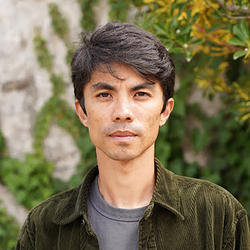
Felipe Shibuya is a visual artist and scientist whose work connects art, design, and biology through investigations of color, form, and pattern. His transdisciplinary background informs his teaching at RISD, where he works across divisions and departments, from first-year students in Experimental and Foundation Studies to graduate students in Landscape Architecture and Interior Architecture. He holds a PhD in Ecology and Nature Conservation from the Federal University of Paraná in Brazil and an MFA in Studio Art from the State University of New York at Buffalo.
Shibuya combines scientific methods with photography, sculpture, video, bacterial cultures, and biomaterials to investigate living systems. Moving between biological observation and material experimentation, his practice makes scientific knowledge accessible while inviting viewers to reconsider their relationships with other organisms.
His research and artistic practice have developed through appointments at Coalesce: Center for Biological Art and RISD’s Edna W. Lawrence Nature Lab, where he served as the Hyundai Biological Programs Fellow. His residencies include LabVerde in Brazil and the Sitka Center for Art and Ecology and MASS MoCA in the United States. His work has been exhibited at the Museum of the City of New York, the Albright-Knox Art Gallery, Museu do Design e da Moda in Lisbon, and Museo Extremeño e Iberoamericano de Arte Contemporáneo in Spain and featured in publications including National Geographic and Ecology.
Academic areas of interest
Shibuya investigates how visibility shapes ecological awareness, with particular attention to color as a means of encountering living systems. He cultivates bacteria until their colonies produce visible pigments, using this emergence of color to draw attention to organisms that often escape everyday perception. The resulting works explore how sensory encounters with microbial life can deepen our understanding of the ecosystems we inhabit.
His research interests include bio art, biodesign, microbial pigmentation, biomaterials, ecological perception, and scientific visualization. Across these areas, he examines how artistic experimentation can support public engagement with science, encourage curiosity, and expand access to knowledge. His practice connects these concerns to a broader question: how might recognizing our interdependence with other species inform more sustainable and just ways of living?