Student Projects — RISD x HMG
From auto safety and performance features to transforming cars vehicles into food production and carbon capture machines, the Hyundai Motor Group (HMG) Regeneration Studio has spurred student innovation at the leading edge of mobility research and development—all informed by nature and living systems. For highlights of recent Regeneration Studio work, see below.
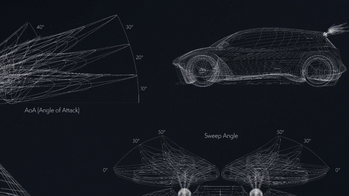
By gathering live visual data and referencing scientific research, Industrial Design student and amateur ornithologist Triff developed a spoiler for small- to mid-sized vehicles inspired by the tail mechanics of the common swift, a small shorebird native to Rhode Island. Referencing the tail shapes the swift uses for different aerial maneuvers, the spoiler allows for variable traction control and improved aerodynamics during common driving situations. Triff used computational fluid dynamics in nTopology to simulate his design’s performance, and the Regeneration Studio partnered with Brown University’s Brueur Wind Tunnel Lab to conduct real aerodynamic testing on Triff’s models.
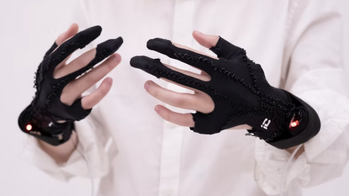
An interest in human cognitive system and sensory substitution led Fitzgibbon to study other organisms such as the water beetle, which can process multiple points of haptic information in order to assess their location, while participating in the Regeneration Studio. The Brown|RISD dual degree student (focusing on cognitive psychology and industrial design) developed a device to provide a type of location-based haptic feedback for users with limited mobility, allowing them to “see” using only the feeling in their hands. Upon completing the course, Fitzgibbon’s research expanded into an Institutional Review Board-approved study to test her design toward a valuable contribution to this emerging research field.
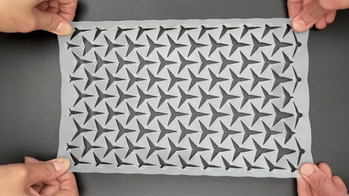
In an effort to combat overheating and stagnant air in vehicle interiors, Lee and Deshpande investigated the stomata found in plant leaves for their ability to regulate moisture within the organism. Through material and geometry-based experiments, they developed a waterproof, breathable, multi-layered system for vehicle exteriors. The system that the Industrial Design and Architecture majors designed can also expand and contract to create either a durable exterior or open high-flow surface, as desired for optimal airflow.
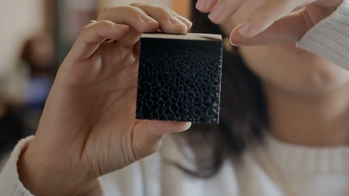
Using the Nature Lab’s scanning electron microscope, Escobar studied the microscopic bone structures and suture geometries of the Red-Eared Slider Turtle, a native east coast turtle species. The Design Engineering major then recreated these geometries at a larger scale to conduct compression and impact testing against existing automotive bumpers. From here, Escobar created a single-material system that distributes impact forces more effectively in both low- and high-speed collisions, increasing driver, passenger, and pedestrian safety, while also reducing waste.
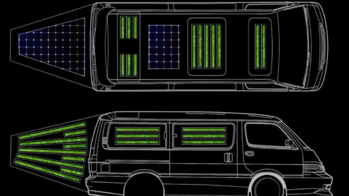
For his Regeneration Studio project, Chapman student set out to explore the question, “Could the future of food be grown on our roadways?” This starting point led the Industrial Design student to explore the potential for algae-based farming to filter carbon dioxide from high-density, polluted areas like highways while continuing to produce nutrient-rich food. Low-cost, scalable, and simple to operate, Chapman’s system leverages algae’s high-efficiency carbon capture to improve urban air quality.