Year Two: Territories of Wood(s)
The material, social, and sustainable lives of wood
Despite being one of the oldest, most widely used construction material, wood is seldom considered in all its social and ecological complexity in contemporary design education discourse and practice. Wood is touted for its sustainable properties, such as regrowth and adaptability, but without full consideration of broader ecological, political, and social dimensions.
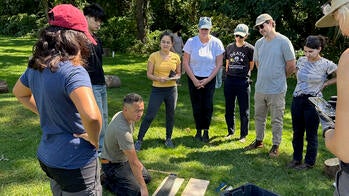
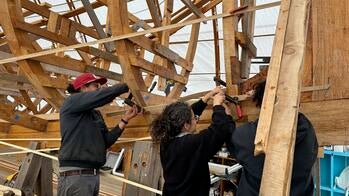
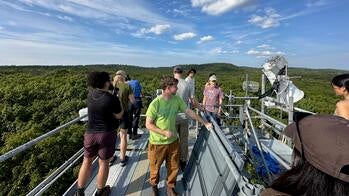
One of the central aims of Territories of Wood(s), the second-year theme of the Sustainability Design Lab (SDL), was to situate wood within this context, towards the creation of environmentally and socially responsible design objects, systems, and strategies. Guided by a cross-disciplinary group of faculty experts, students questioned common assumptions about the material through research, experimentation, and hands-on making for a full academic year. Investigation took place in the classroom, in studios, and in the field, building awareness of a design decision’s sociocultural implications, as well as its potential for advancing sustainability causes.
While also participating in several collaborative projects, students took individual thesis work from concept to execution, resulting in original interventions in sustainable design via inventive uses of wood.
Territories of Wood(s) in depth
Get a closer look at the studio activity—both on and off campus—through which students made clear statements about the sustainable potential of wood.
Learn about the faculty field experts who provide the lab’s pedagogical framework for inspiring innovative, ecologically responsible design solutions.
Meet the second cohort of Sustainability Design Lab students and preview thesis projects that emerged from Territories of Wood(s).
See how local knowledge and resources informed the design thinking and processes that emerged out of the SDL’s second year of activity.
View work from the lab’s second annual exhibition—a collection of individual works and a group statement on wood’s potential to bring about sustainable design futures.