
Students in an interdisciplinary fall course learn to observe the living world in search of design strategies grounded in planetary health.

For the past 35 years, RISD students have had their eyes opened to the pervasive power of propaganda thanks to a History, Philosophy, and the Social Sciences course taught by Senior Lecturer Tom Roberts. The course traces the history of propaganda over 2,000 years and examines how its elements and techniques have remained surprisingly unchanged from its earliest forms to today’s digital formats. The goal, says Roberts, is “to provide students with knowledge that will enable them to recognize propaganda messages directed at them now and in the years ahead.”
Roberts uses a lot of visual content in his teaching at RISD. In addition to readings, students respond to posters, films, monuments, paintings, and photographs created expressly to shape public opinion and influence behavior. He dedicates a sizable portion of the semester to Nazi propaganda, which he describes as “one of the most successful propaganda campaigns in history and the principal reason why the word propaganda has such negative connotations.”
Students read excerpts from an antisemitic eighth-grade textbook the Nazi regime disseminated to warn young people about the dangers of diluting “pure Aryan bloodlines” and destroying the health of (gentile) German citizens. They concurrently studied CBS news correspondent William L. Shirer’s Berlin Diary: The Journal of a Foreign Correspondent, 1934–1941.

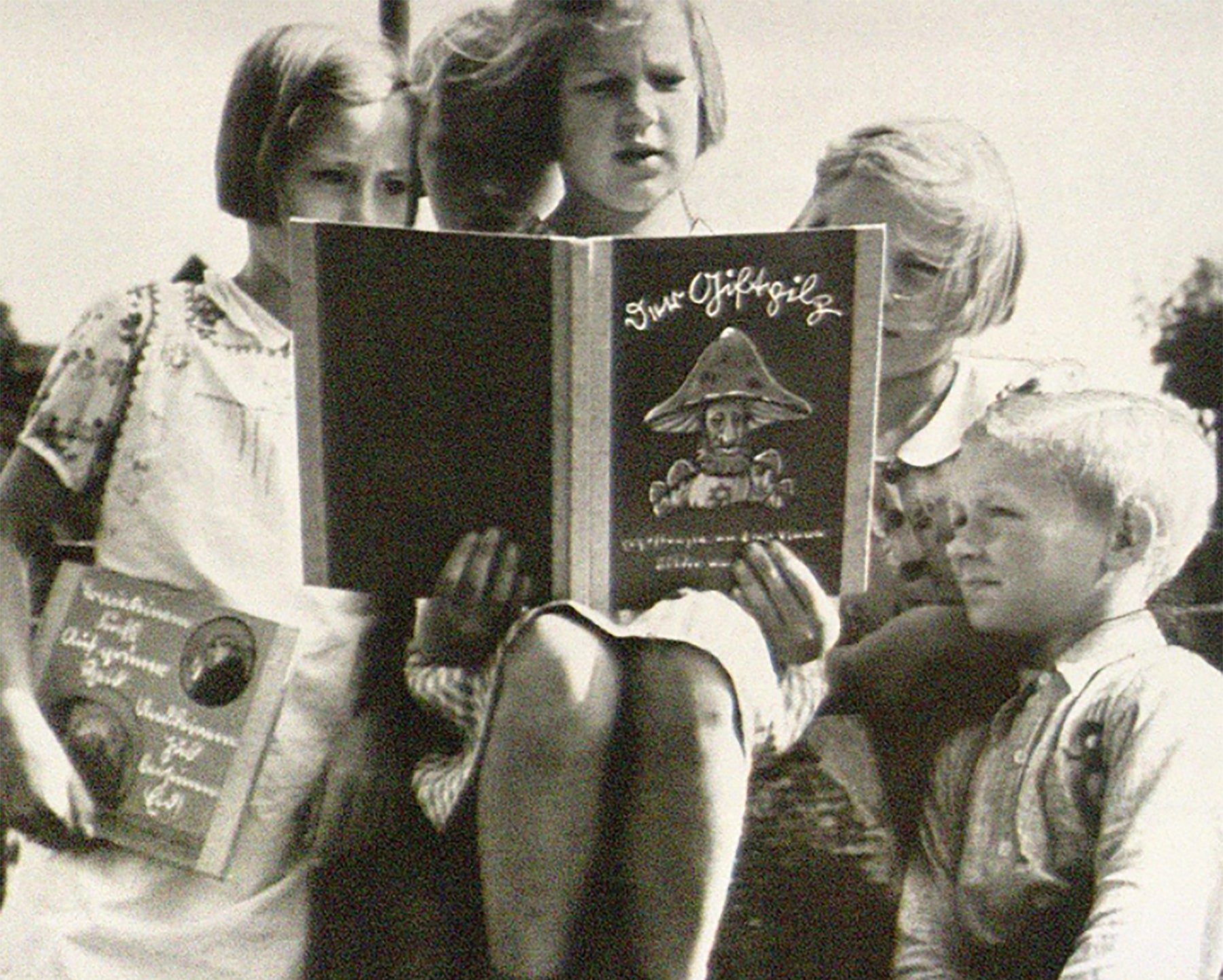
In the classroom discussion that followed, students again and again asked why the German people were willing to buy into the regime’s hateful propaganda. Weren’t they paying attention? “I’ve been teaching this class for a long time, and I’ve always had that question,” Roberts responded. “Propaganda appeals to emotions, not to thought. And the racist ideas and laws used to enforce them were introduced gradually, which made them more difficult to notice.”
Several students drew parallels between what was happening in Europe in the years leading up to World War 2 and what’s happening today in the US, as Immigration and Customs Enforcement agents round up tens of thousands of immigrants for detention and deportation. Roberts noted that such government actions usually involve nameless, faceless people, turning them into numbers and statistics rather than human beings. He pointed out how anti-ICE activists are combatting that play by putting faces on the victims, in one case that of five-year-old Liam Conejo Ramos, who was photographed wearing a fuzzy blue hat and a Spider-Man backpack. “Those photos in the media are essentially another form of propaganda,” he explained.

He went on to identify the moment in history, November 1938, when Nazi propaganda turned into murderous action in the form of the Nuremberg Laws. They stripped Jewish citizens of their rights and paved the way for what Nazis referred to as “the final solution,” the systematic murder of millions of men, women, and children. The regime declared “a great racial war on Jews” following Kristallnacht (The Night of Broken Glass), when Jews were attacked by the thousands and their businesses were destroyed in response to a Jewish student in Paris who shot a government worker at the German Embassy.
The class watched excerpts from anti-Jewish propaganda films of the time like Jud Suss and The Eternal Jew, which reinforced negative stereotypes and flooded Germany with Hitler’s ideas. This “othering” of an entire people struck a chord for a Black student in the class, who recalled his parents teaching him the dangers of being Black in America and how racist perpetrators of violence similarly claim to be the victims. “Yes,” commented Roberts, who is retiring at the end of the term, “an effective propagandist accuses others of doing what they are doing in order to justify revenge.”
As the semester nears completion, the class is working on researched, documented, and annotated visual term projects in the form of posters, presentations, websites, and videos responding to contemporary social or political issues or a historical issue covered in the class. They are joining the nearly 600 RISD students who have completed the course since it was launched in 1990. “And the world keeps giving us new propaganda material to keep it fresh,” says Roberts.
Top image: Tom Roberts shares work by sophomore Cameron Feng
Simone Solondz / photos by Kaylee Pugliese
May 21, 2026
Students in an interdisciplinary fall course learn to observe the living world in search of design strategies grounded in planetary health.

The once-vibrant, multiracial Providence community was razed in the 1800s to make room for the railroad and the Rhode Island State House.

SEI Research Fellow Nichole Rustin engages RISD students in contemporary political questions and develops their skills as liberal arts scholars.