
The class studied inlay, overlay, and engraving processes, reimagining the relationship between the functional and the ornamental.

“I like this double pleat you developed,” said faculty member Lauren Gideonse, “and it seems to be helping this wall to stand. I wonder if it would be useful to experiment with horizontal corrugation as well.”
Gideonse was speaking to students in a Wintersession class she co-taught with textile designer and architect Susan Williams 14 TX as they worked together to create a free-standing paper structure in the Bayard Ewing Building’s main gallery. Offered through the Architecture department, Separated at Birth (Textile & Paper Applications in Architecture) explored the interwoven histories and shared tectonic vocabulary of paper fabrication, textile production, and architectural design, allowing students to consider experimentation in material behavior as a driver of architectural decision making.
“We got the idea for this course one day when we were making paper together in Lauren’s kitchen,” said Williams. “Paper and textiles have similar industrial histories and are treated similarly in architectural model making.”

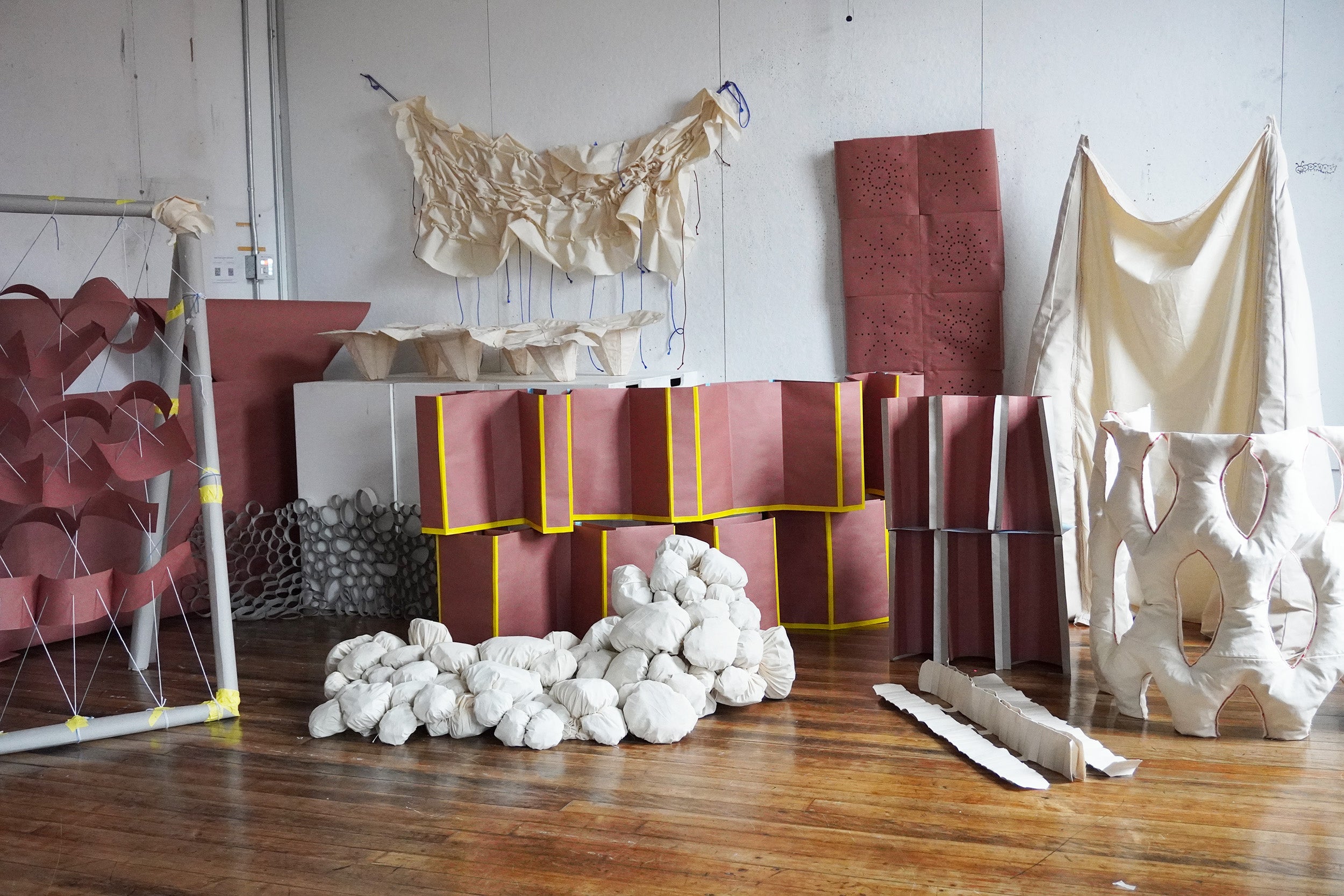
Both materials are essentially entanglements of fibers into thin, pliable surfaces, the faculty team explained. In their simplest states, both perform well under tension and fail quickly when compressed. Together they provide alternative perspectives on traditional architectural problems such as joining, non-linear material scaling, structural and surface obligations, replicability, and collective production.
Over the course of the five-week term, the class experimented with different kinds of paper as well as cotton-based fabrics like muslin and canvas. Each assignment posed generative questions regarding structure, scale, ornamentation, and moments of human-scale interaction. Are you choosing materials based on their performance, or are you altering the material to affect its behavior? How will you maintain a level of rigidity with a larger surface area? How does proportion play into the design’s form and structural integrity?
In-class projects included using heavy paper and a variety of other materials to build small models and architectural elements. Students also explored swatch-making as a methodology for testing material manipulation. “We set up those assignments to get students thinking about the use of panels, assembly, and the industrial history of the materials,” said Williams. “Using the same materials over and over builds familiarity.”
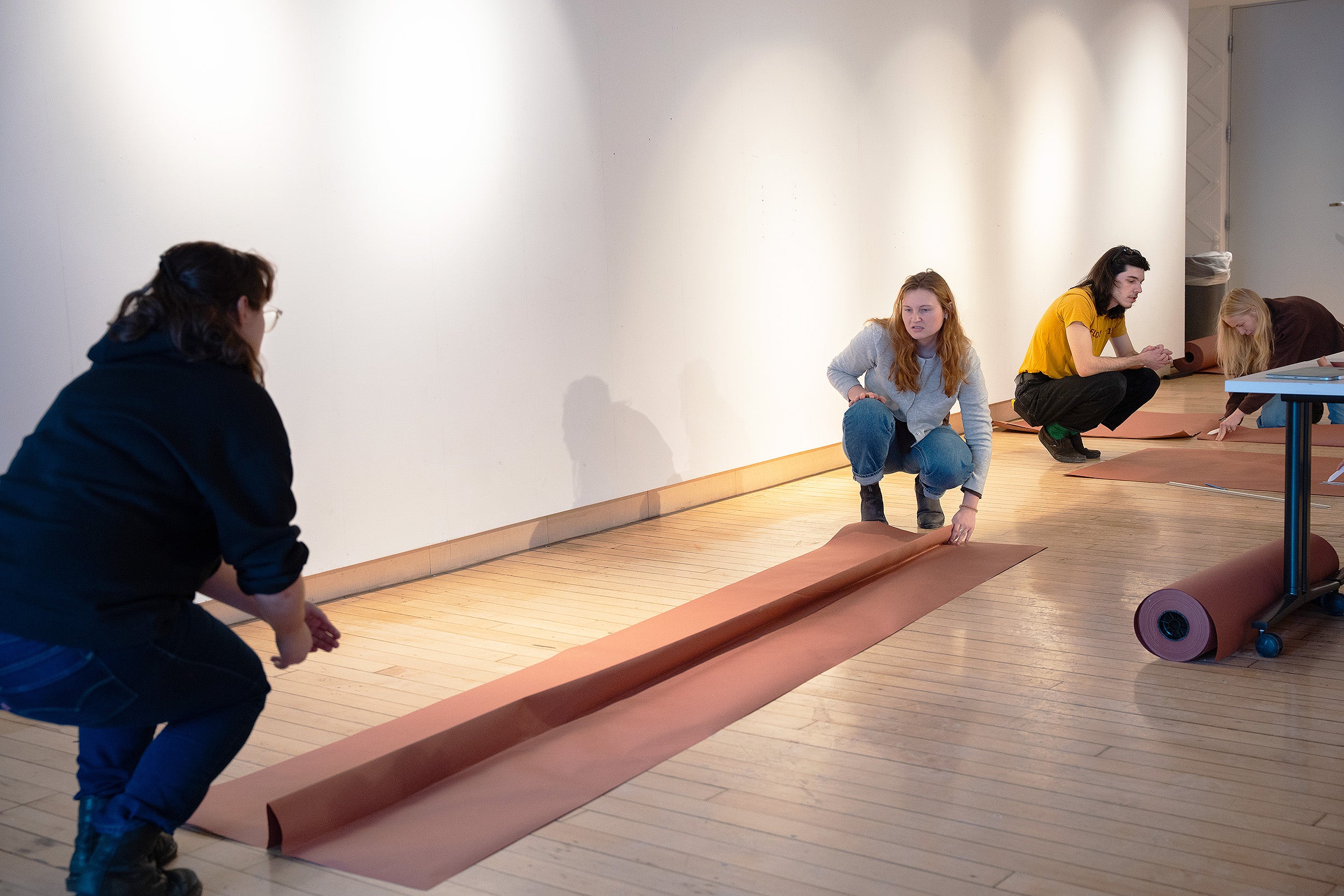
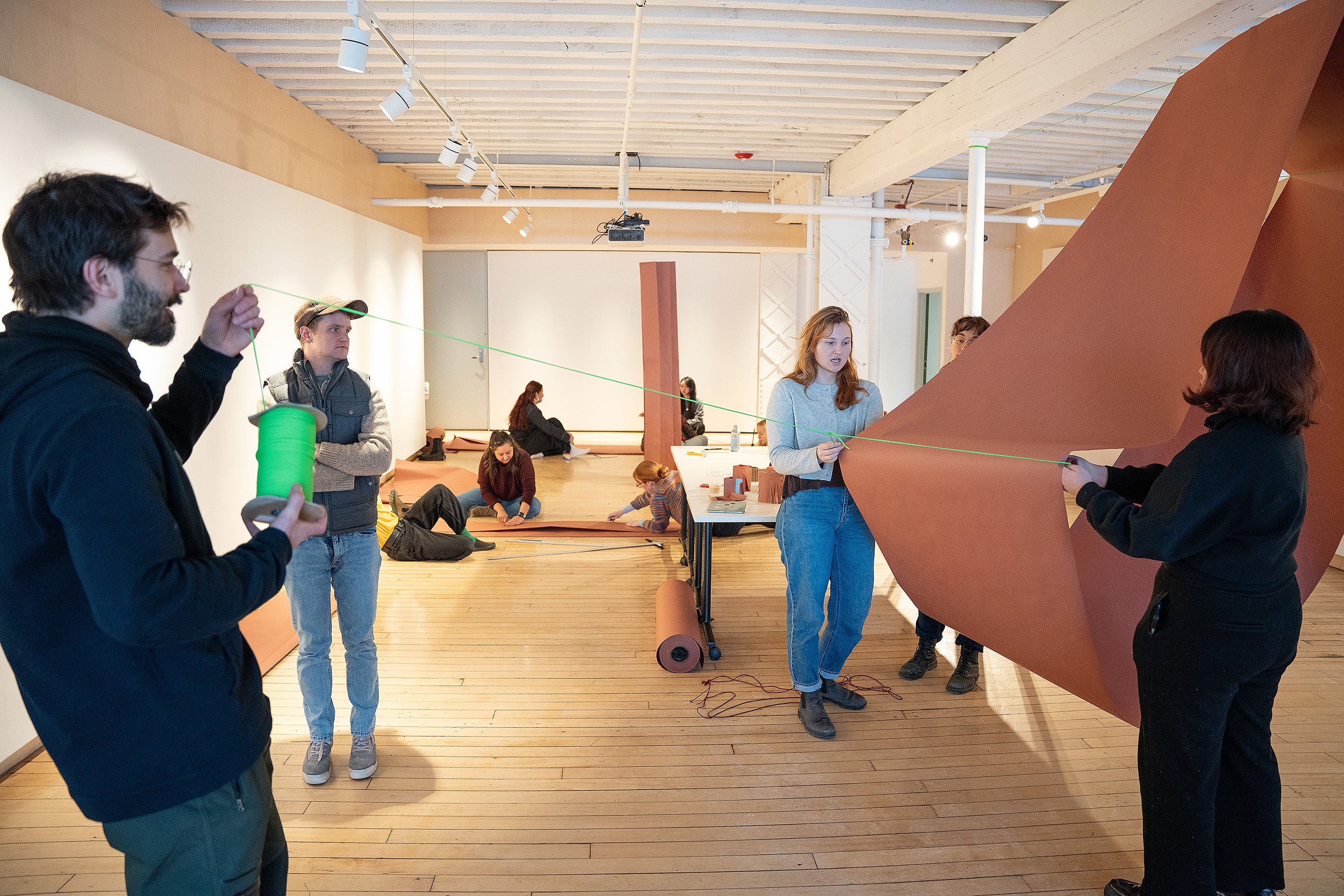
The class collaborated on two big builds or “sprints.” For the first one, they made 4x4-foot, free-standing assemblies, and for the second, they used that same heavy paper to create a 160-sf structure. They began the second build by working in three teams to test different approaches and circumvent any potential issues. “The goal is to work quickly and collaboratively,” said Williams. “Cooperative decision making is key.”
“Working with paper is challenging because it doesn’t have stiffness and it’s hard to get it to do what you want,” said grad student Matt Mulberry MArch 27. “So, the material forces you to be less rigid in your design decisions. This course is really inspiring me to think about pushing convention and considering other materials for creating different types of spaces.”
Simone Solondz / top photo by Susan Williams
March 11, 2026
The class studied inlay, overlay, and engraving processes, reimagining the relationship between the functional and the ornamental.

Students considered how sound can serve as a spatial and experiential medium, guiding attention, shifting atmosphere, and provoking new forms of encounter.

Working collaboratively, students are designing and building exhibits in preparation for an immersive show in the Center for Integrative Technologies.